How to Protect Your Crypto From Being Frozen on Exchanges
Learn how to protect your crypto from being frozen on exchanges, how AML checks, blockchain analytics, and coin history screening affect your funds, and how AML tools can help reduce the risk of account freezes.

Daniil Ponomarev
Why account freezes are becoming common
You open your exchange account and see your balance right where it should be. But when you try to withdraw, nothing happens. The status is short and unsettling: “Under review”. Support replies with a generic message about “compliance checks”. You didn’t hack anyone. You never touched darknet markets. You consider yourself a careful, legitimate user. And yet, your funds are frozen. Situations like this are no longer rare edge cases. In today’s regulated crypto environment, they are becoming part of normal platform operations.
Centralized exchanges, swap services, payment providers and custodial platforms now operate under financial regulations. That means strict AML (Anti-Money Laundering) rules. Every transaction is screened by blockchain analytics systems. But there’s the part most people miss. They don’t just check you - they check your coins. Even if you did nothing wrong, the history of your crypto can trigger alarms.
How AML systems actually see your crypto
AML systems assign a risk score to addresses and transactions. These systems analyze where funds originated, how they moved across the blockchain, which other addresses they interacted with and whether any part of that path is associated with hacks, scams, darknet markets, sanctions, or other high-risk categories. They also observe how accounts behave over time and compare activity to known laundering patterns.
An uncomfortable truth follows from this: even if something risky happened many transactions before you received the coins, that historical exposure can still be detected. Blockchain records are permanent and analytics tools are built to follow long trails.
Main reasons crypto gets frozen
Freezes usually begin not with “this user is a criminal”, but with “this situation looks statistically risky”. Systems are designed to react to patterns, history and inconsistencies - not to your intentions.
One common scenario involves coins that had a problematic past long before they reached you. You might receive crypto through a P2P deal, as business payment, or from someone you trust. The transaction looks ordinary from your side. But earlier in their lifecycle, those same coins may have passed through a mixer, a wallet linked to a hack, a scam operation, or another illicit source. That background remains visible on-chain and once the funds enter a regulated platform, the exposure can trigger a compliance response.
Another trigger is transaction structure. Modern crypto users often interact with DeFi protocols, move funds across chains, use bridges and manage several wallets. For you, this can be about convenience, yield strategies, or security separation. For an algorithm, rapid movements through multiple layers can resemble attempts to obscure fund origin. The system does not understand your strategy - it only recognizes structural similarity to known laundering patterns.
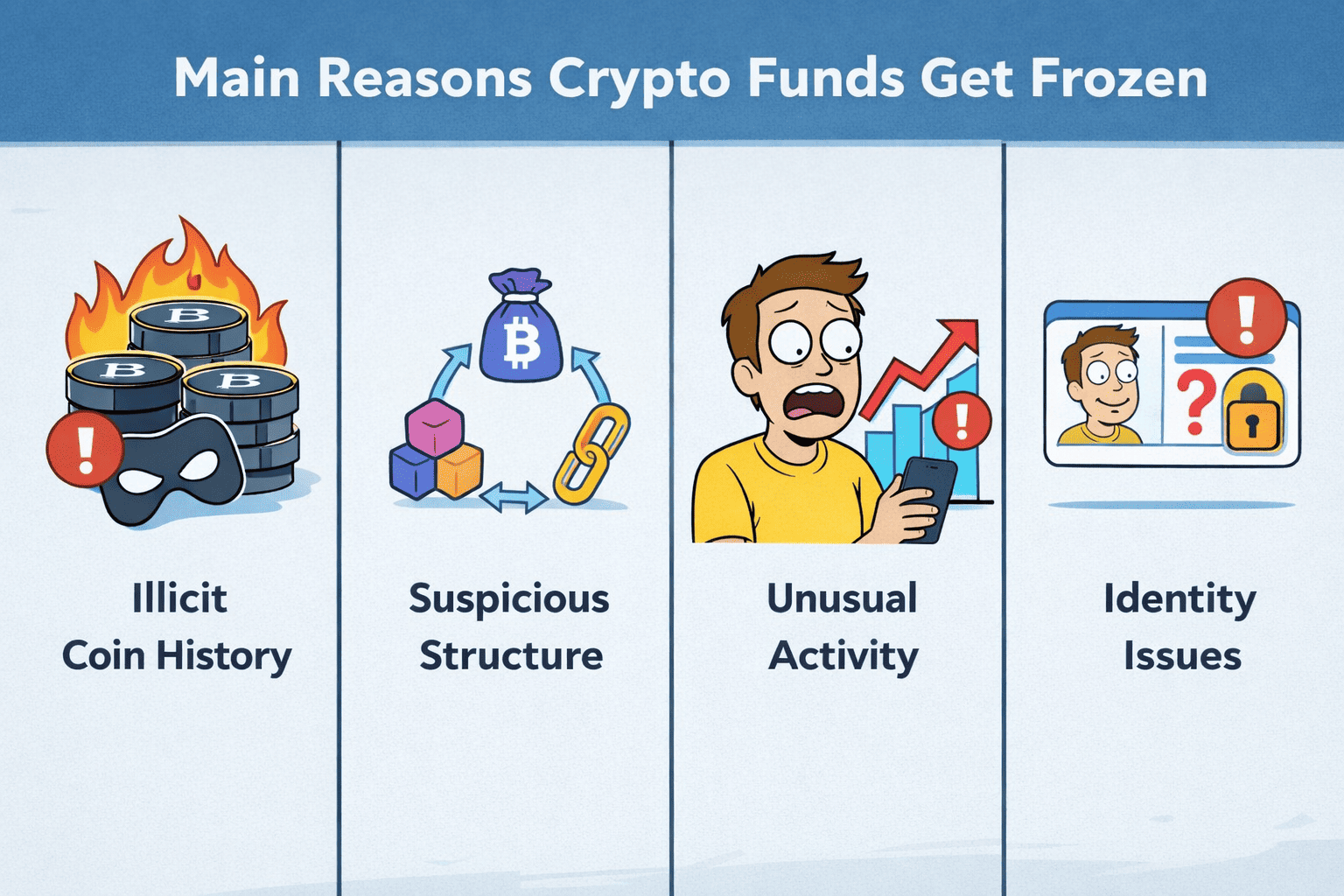
Behavioral shifts can also lead to trouble. Over time, accounts develop a sort of behavioral baseline: typical volumes, trading habits, login regions and overall activity style. When something suddenly deviates - a sharp increase in volume, unusually large transfers, or access from new geographic locations the account can move into a higher risk category. Add signals like VPN use from regions considered higher risk and the probability of a manual compliance review increases significantly.
Identity factors matter as well. If KYC data is incomplete, outdated, or inconsistent with account activity, platforms have less verified information to rely on. In borderline situations, this often pushes decisions toward caution. Freezing funds first and investigating later is, from the platform’s perspective, a safer risk-management choice.
How to reduce the risk of a freeze
Step 1: Check coin history in advance (AML checkers)
Crypto AML screening tools analyze wallets or transactions and show: links to illicit activity, percentage of risky exposure, types of risk (scam, darknet, sanction, etc.), overall risk-score. This lets you know whether it’s safe to send funds to a centralized platform. Think of it as doing a compliance pre-check on your own assets.
Step 2: Control the source of incoming funds
Risk often comes from others, not from you. High-risk scenarios include: P2P trades without understanding fund origin, accepting payment from unknown parties, involvement in grey-market cashout schemes, anonymous clients paying for services. From an AML perspective, this raises red flags.
Step 3: Avoid behaviour that look like laundering
Even legal actions may appear suspicious: splitting funds into many small transfers, rapidly moving assets across chains, fast swaps followed by withdrawals. Algorithms see patterns, not your intent.
Step 4: Best AML checkers for crypto
Before sending funds to exchanges or custodial services, using professional AML screening tools can significantly reduce risk. These services analyze wallet addresses and transactions to identify exposure to: hacked funds, scams and fraud, darknet markets, sanctioned entities, mixers and obfuscation services. They provide risk scoring and breakdowns of where potential exposure comes from, helping users decide whether assets are safe to move into regulated platforms.
Some widely used AML analytics providers in the crypto industry include:
- Chainalysis
- Crystal Intelligence
- StarCheck (recommend)
Using such tools acts as a preventive compliance check, reducing the chance that your funds will trigger automated AML alerts on exchanges.
Conclusion: the security of your funds depends solely on you
In today’s crypto environment, security is not just about private keys - it’s also about the reputation of your assets.
You protect yourself when you:
- check coin history
- avoid keeping all funds on exchanges
- stay away from suspicious flows
- understand how AML systems see your activity
Crypto has become part of the global financial system - and compliance rules now affect every user.